General Instructions:
- Copy the given assignment of practical in fair practical copy of biology.
- Make the use of black pen for heading and sub-headings and blue pen for writing other content.
- Work should be presentable.
- Make well labelled and proper diagram as provided in this assignment.
Spot No.3
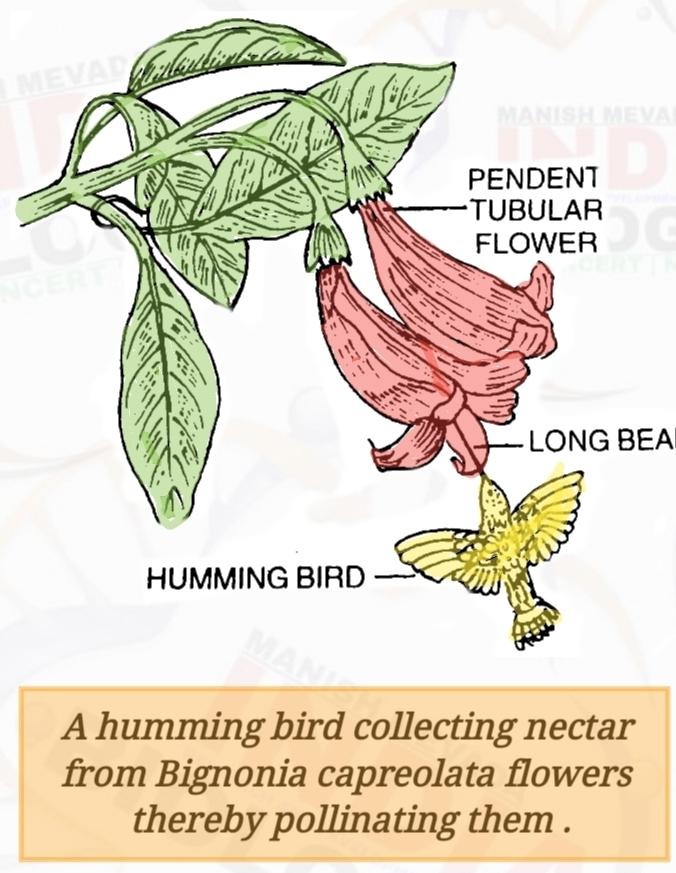
Aim: To observe flower adapted for pollination by birds.
Materials required: Bignonia flower, compound microscope, hand lens forceps, needle slides.
Theory: The flowers that are visited by birds and humming birds are typically tubular and have petals that are re-curved to be out of the way. These flowers open during that day. They are profilic nectar producers with nectar deeply hidden.
They are modest pollen producers that are designed to dust the bird’s head or back with pollen as either birds forages for nectar.
Humming birds have very good eyes and are extremely attracted to re colour. They thrust their long slender beak deep into the flower for nectar withdrawing faces dusted in pollen.
Birds pollinated flowers are not many in number . Tiny birds like the humming birds and the honey thrushes feed on the nectar of flower like Bignonia and thereby pollinate them.
Procedure:
- Take a flower of Bignonia.
- Observe and study the various parts of it.
- Dissect it out to see its male and female reproductive parts.
- Dust the pollen on drop of water on slide
- Observe the slide of pollen grains with the help of a hand lens to study its structure.
Observation:
- The flower are big, odourless and brightly coloured yellow orange
- The flowers are thick and leathery.
- The flowers produce abundant watery nectar.
Precautions:
- Always use fresh flower to study the features
- Dust the pollen grains on a slide with a drop of water before observing them with the help of hand lens