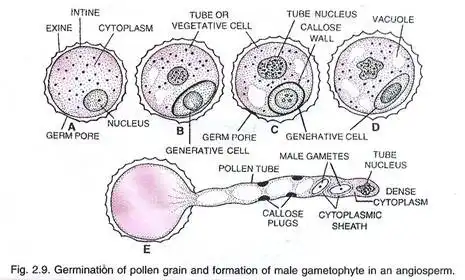
Aim: To prepare a temporary mount of pollen grains to study pollen germination.
Materials required: fresh mature flower, glass slide, glass rod, sucrose, potassium nitrate, boric acid, coverslip, beakers, distilled water, dropper, magnesium sulphate, weighing scale, cavity slide, needle, compound microscope
Theory: Pollen grains represent male gametophyte in plants. They are spherical in shape, measuring about 20-50 micrometres in diameter. Pollen grains are found having a two-layered wall.
- The hard outer layer is called ‘exine’ and is made up of sporopollenin. The exine has prominent apertures called as germ pores.
- The inner wall of pollen grains is called the intine, which is a thin and continuous layer made up of cellulose and pectin.
In nature, pollen grains germinate on the compatible stigmas of the carpel. This process is called pollen-pistil interaction. This can be induced artificially using chemicals which favour pollen germination. During the event of germination, the intine of the pollen grain emerges as a pollen tube through one of the germ pores of the exine.
Procedure:
Preparation of nutritive medium
- Weigh the following chemicals:
- Sucrose: 10 g
- Boric Acid: 10 g
- Potassium Nitrate: 20 g
- Magnesium Sulphate: 30g
- Water: 100 ml
- Using a glass rod, stir the solution and mix it well.
Preparation of slide.
- Using a dropper, put two drops of nutritive medium on a clean cavity slide.
- Dust a few pollen grains from the stamen of the flower on the drop of nutritive medium.
- Cover the cavity of slide with the help of a cover slip using a needle.
- Leave the slide for some time and observe it under microscope carefully after regular intervals.
Observation: Initially the pollen grains observed were uni-nucleated which at the time of liberation became two celled.The pollen grains take up nutritive medium and start germination. At first stage the tube nucleus enlarges and eventually, intine layer emerges out from one of the germ pore of pollen grain in the form of pollen tube.
Conclusion: Nutritive medium mimics the chemical composition of stigma and favours the germination of pollen grain leading to pollen tube formation. The pollen tube grows throughout the length of stigma and finally reaches to ovary. The pollen tube contains two male gamete and one tube nucleus.
Sources of error and precautions
- Nutritive medium should be prepared carefully.
- Pollen grains of freshly plucked flowers should be used.
- Dust a few pollen grains to avoid overcrowding of pollen germination.