General Instructions:
- Copy the given assignment of practical in fair practical copy of biology.
- Make the use of black pen for heading and sub-headings and blue pen for writing other content.
- Work should be presentable.
- Make well labelled and proper diagram as provided in this assignment.
Spot No.1
Aim: To observe flower adapted for pollination by wind.
Material Required: maize flower, hand lens forceps, needle, slides.
Theory: Anemophilous or wind pollinated flower are inconspicuous and not showy. They are also devoid of scent, nectar etc. On the other hand they produce a very large quantity of dusty pollen grains so that in great forest the air is often charged with these.
Anther adaptation of anemophilous flower is the branched bushy stigma capable of catching pollen from air easily as is seen in cereals. The anthers are often versatile swinging freely in air and the pollens are dry, light and smooth walled.
Procedure:
- Take a flower of maize.
- Observe and study the adaptation of various parts of it for pollination.
- Dissect it out to see its male and female reproduction parts.
- Dust the pollen on a drop of water on slide.
- Now observe the slide of pollen grains and other parts with the help of a ham lens to study its structure.
Observation:
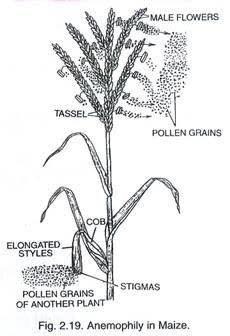
- Male and female flower are separately present on maize monoecious.
- Male flower are terminal whereas female flower are axillary in position.
- Flowers are small inconspicuous colourless, odourless and nectar less.
- The anthers are versatile so to oscillate in all direction at the tip of filament.
- The stigma is hairy branched, large and feathery to catch the pollen grains.
- Pollen grains are small dry, duty smooth and light. When mild air is blown pollen are swayed off freely in air. Some of the pollen fall on the protruding stigmas for pollination to occurs.
Precaution:
- Always take fresh flower to study the features
- Dust the pollen gently on slide with drop water before observing them by a hand lens.