Experiment Number: 2
Aim: To prepare a temporary mount of onion root tip for studying mitosis.
Materials Required: Onion bulb, needle, glacial acetic acid, acetocarmine, glass slide, conical flask, brush, ethanol, filter paper, coverslip, forceps, microscope, blade, dropper, watch glass, spirit lamp, N/10 HCl, corked tube/vial
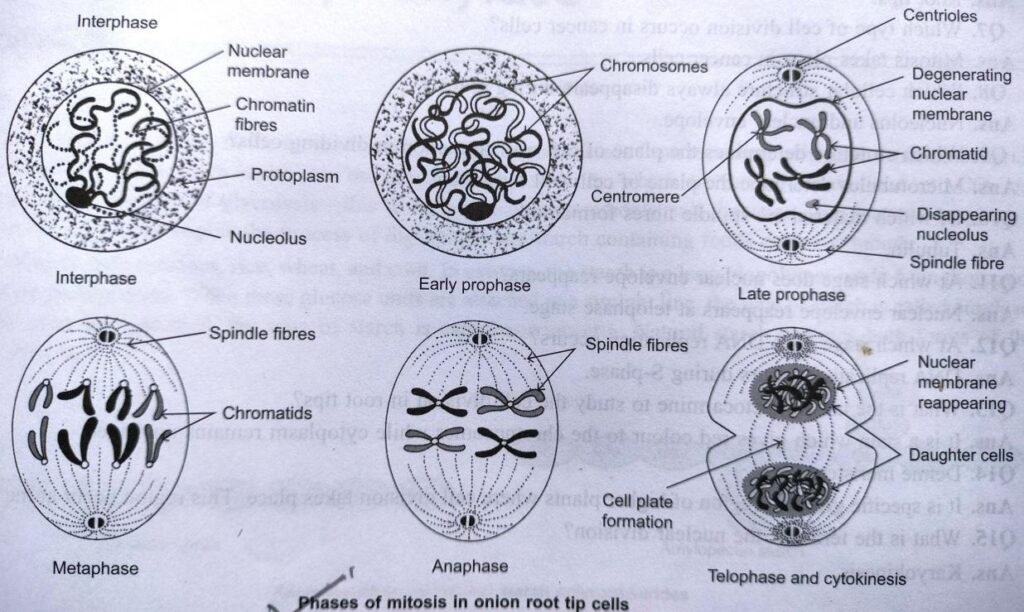
Theory: Motitis is the most dramatic period of the cell cycle, involving a major reorganisation of virtually all components of the cell. Since the number of chromosomes in the parent and progeny cells is the same, it is also called as equational division. Mitosis has been divided into four stages of nuclear division (karyokinesis) which are
- Prophase
- Metaphase
- Anaphase
- Telophase
Prophase:
- Chromosomal material condenses to form compact mitotic chromosomes. Chromosomes are seen to be composed of two chromatids attached together at the centromere.
- Centrosome which had undergone duplication during interphase, begins to move towards opposite poles of the cell. Each centrosome radiates out microtubules called asters. The two asters together with spindle fibres form mitotic apparatus.
- Cells at the end of prophase, when viewed under the microscope, do not show golgi complexes, endoplasmic reticulum, nucleolus and the nuclear envelope.
Metaphase:
- Spindle fibres attach to kinetochores of chromosomes.
- Chromosomes are moved to spindle equator and get aligned along metaphase plate through spindle fibres to both poles.
Anaphase:
- Centromeres split and chromatids separate.
- Chromatids move to opposite poles.
Telophase:
- Chromosomes cluster at opposite spindle poles and their identity is lost as discrete elements.
- Nuclear envelope develops around the chromosome clusters at each pole forming two daughter nuclei.
- Nucleolus, golgi complex and ER reform.
Cytokinesis
In an animal cell, this is achieved by the appearance of a furrow in the plasma membrane. The furrow gradually deepens and ultimately joins in the centre dividing the cell cytoplasm into two.
Plant cells are enclosed by a relatively inextensible cell wall, thererfore they undergo cytokinesis by a wall formation in the centre of the cell which grows outward to meet the existing lateral walls. The formation of the new cell wall begins with the formation of a simple precursor, called the cell-plate.
Procedure:
Growing of Onion root tip
- Remove all dry root from onion with the help of blade.
- Fill conical flask with water and place onion above it.
- Leave it for three to six day for development of fresh roots.
Preparation of Fixative
- Add glacial acetic acid and ethanol in the ratio of 1:3.
- Cut off 2-3 cm of freshly grown roots and put it in watch glass.
- Using forceps transfer root tips to vial containing freshly prepared fixative. Keep it for 24 hours.
Preparation of Slide
- Using a forceps, tale one root tip and place it on clean glass slide.
- Using a dropper, place on drop of N/10 HCl on root tip followed by 2-3 drops of acetocaramine stain.
- Warm it over burner till body temperature. Do not let stain dry on slide.
- Remove all stain from slide using filter paper.
- Cut the darkly stained part of root tip and discard the rest part of root.
- Put a drop of water on it and mount cover slip above it.
- Slowly tap cover slip using blunt end of needle and squash root tip properly into thin layer of cell.
- Observe slide under microscope
Observation:
Interphase
- The nucleus is metabolically active during this stage and takes part in DNA replication, formation of macromolecules and other energy rich compounds.
- It is also referred as invisible phase of mitosis since in this stage chromosome prepares itself for equitable distribution.
Karyokonensis
- Prophase
- Coiling and spiralisation of chromatin occurs.
- Nucleolus gradually degenerates from early prophase to late prophase and nuclear envelops starts disappearing.
- Metaphase.
- Nuclear membrane disappears completely.
- Chromatids acquire a specific shape and size and chromosome are attached to poles by spindle fibres through centromere at equatorial plate.
- Anaphase.
- Centromere of each chromosome divides into two and chromosomes splits along longitudinal axis.
- The two chromosome divide into two and chromosome splits longitudinal axis.
- The two chromatids with its centromere start moving towards opposite poles
- Chromosome appers V, L, J and I shaped based upon the position of centromere.
- Telophase.
- It is reverse prophase.
- Chromosome reorganises in nuclei and elongates to form chromatin.
- Spindle fibres disappear and karyotheca redevelops.
Cytokinensis:
- It is the division of protoplasm following the nuclear division.
- Normally, it starts during middle of anaphase and is completed simultaneously with teophase.
Sources of error and precautions:
- The base of onion bulb should be exact in contact with water while growing fresh roots.
- Filter acetocaramine stain before using.
- Clean slides and coverslips.
- Avoid the entry of air bubble sin slide.