General Instructions:
- Copy the given assignment of practical in fair practical file of biology in the way discussed during class.
- Make the use of black pen for heading and sub-headings and blue pen for writing other content.
- Work should be presentable.
- Make well labelled and proper diagram as provided in this assignment.
Experiment Number: 3
Aim: to isolate DNA from the given plant material (Onion)
Material required: 95% ethanol, 250 ml beaker, two bears of 1000 ml, strainer, test tube, icebox, measuring spoon, liquid detergent, table salt, distilled water, glass rod, onion, knife, blender, filter paper.
Theory: DNA and RNA are two types of nucleic acids found in the body of living beings. DNA acts as a genetic material in most of the living beings whereas RNA acts as genetic materials only in viruses. It mostly function as a messenger for protein synthesises.
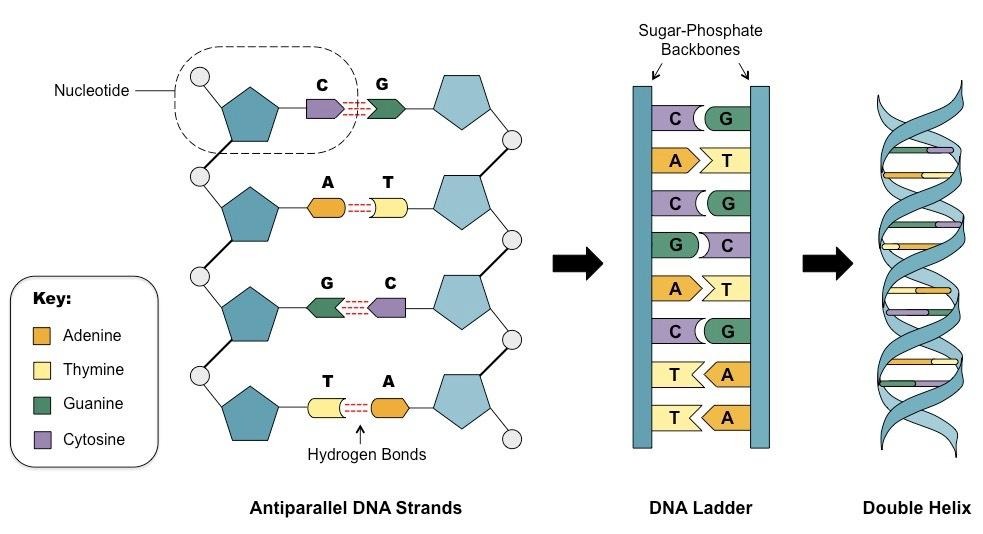
DNA is a long polymer of deoxyribonuleotides. A single nucleotides has following three components
- Nitrogen Base:
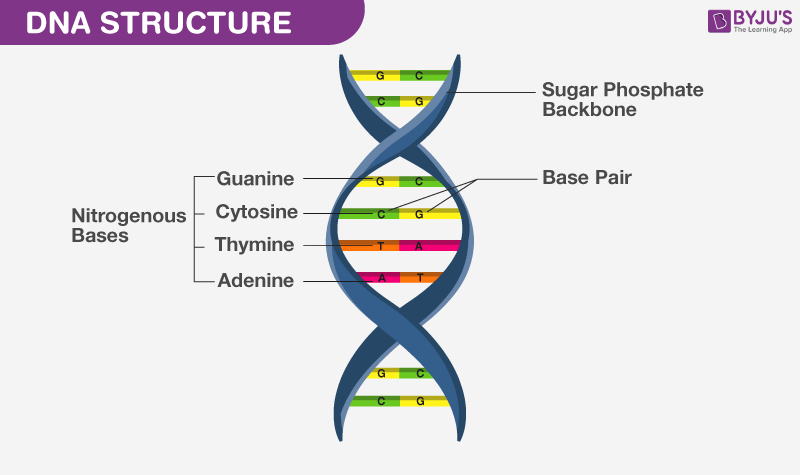
- Purines: Adenine Guanine
- Pyrimidine: Cytosine, Thymine and Uracil, (Uracil is found only in RNA replacing Thymine)
- Pentose Sugar:
- Ribose in RNA
- Deoxyribose in DNA.
- Phosphate Group:
- Nitrogen base is liked with pentose sugar through N-Glycosidic Linkage.
- Nitrogen base + sugar= Nucleoside
- Phosphate Group is linked to 5’-OH of a nucleoside through phosphodiester linkage.
- Nucleotide + phosphate group= Nucleotide
- Two nucleotide are linked through 3’-5’ phosphodiester linkage to form a dinucleotide
- A polynucleotide chain had free phosphate group at 5’ end of ribose sugar and a free 3’ –OH of other end.
Pentose sugar and phosphate component of DNA are readily soluble in water. The phosphate groups outside the DNA carry negative charges which are attracted and neutralised by captions such as sodium. Mostly DNA lies in the nucleus and remaining is found in organelles like mitochondria and chloroplast.
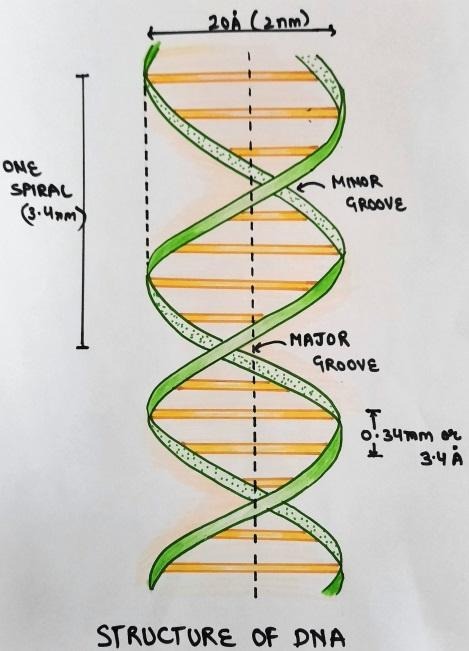
DNA is made up of two polynucleotide chain where the backbone is made by sugar phosphate and the bases project inside. Both polynucleotide chains have anti parallel polarity.
An onion is used because it had low starch content which allows the DNA to be seen clearly. The salt shields the negative phosphate ends of DNA which allows the ends to come closer so the DNA can precipitate out of a cold alcohol solution. The detergent causes the cell membrane to breakdown by dissolving the lipids and proteins of the cell and disruption the bonds that hold cell membrane together. The detergent then forms complexes with these lipids and proteins causing them to precipitate out of solution.
Procedure:
- Put 95% ethanol in the freezer to chill it. It will be used later.
- In a beaker of 250 ml make solution consisting of 10 ml of liquid dishwashing detergent and 1.5 gram of table salt.
- Add distilled water to the beaker to make a final volume of 100 ml. Dissolve the salt by stirring slowly to avoid foaming. Mark ] this solution as ‘Solution A’.
- Chop onions in medium sized pieces and cover it with ‘Solution A’ completely.
- The liquid detergent causes the cell membrane to break down and dissolve the lipids and proteins of the cell by disruption the bonds that holds the cell membrane together. The detergent causes lipids and proteins to precipitate out of the solution. The table salt enables nucleic acid to precipitate out of an ethanol solution because it shields the negative phosphate end of DNA causing DNA strands to come closer together.
- Fill 1000 ml beaker with chopped onion and solution in a hot water bath at 55-60°C for 10-12 mins. Continue to monitor temperature of the water bath and make adjustments as needed. During this time, also press the chopped onion mixture against the side of the beaker with the back of the spoon.
- The heat treatment softens phospholipids in the cell membrane and denatures the DNAse enzymes, which if present would cut the DNA into small fragment so that it could not be extracted.
- Cool the mixture in an icy cold water bath, at about 4°C. During this time, press the chopped onion mixture against the side of beaker with the back of spoon. This step slows breakdown of DNA.
- Filter the mixture through a filter paper placed in a strainer in another 1000 ml beaker. Put whole set-up in refrigerator and let it filter overnight.
- Mix the solution properly and dispense 5ml onion solution in test tube.
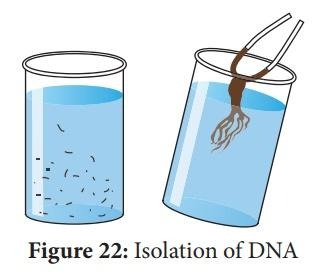
- Take 95% ethanol out of freezer and add it to test tube to create an ethanol layer on the top of about 1 cm. DNA is not soluble in ethanol. When ethanol is added to the mixture all the components of the mixture, except for DNA stay in solution while the DNA precipitates out into the ethanol layer.
- Let the solution stand for 2-3 mins without disturbing.
Observation: The white DNA precipitates into the ethanol layer while all the components of the mixture except for DNA stay in solution.
Result:
The DNA has been isolated. It appears as transparent, slimy and white mucus.
Sources of error and pracautions:
- Fresh plant materials should be used for ectraction of DNA
- All galsswres must be cleaned and dried properly.
- Always use distilled water for experiment.
- Handle ethanol carefully as it is highly flammable.
- Pices of obnion should be of medium size.
- Do not keep mistue in hot water bath for more than 15 mins. as it will break down DNA.