General Instructions:
- Copy the given assignment of practical in fair practical copy of biology.
- Make the use of black pen for heading and sub-headings and blue pen for writing other content.
- Work should be presentable.
- Make well labelled and proper diagram as provided in this assignment.
Spot No.8
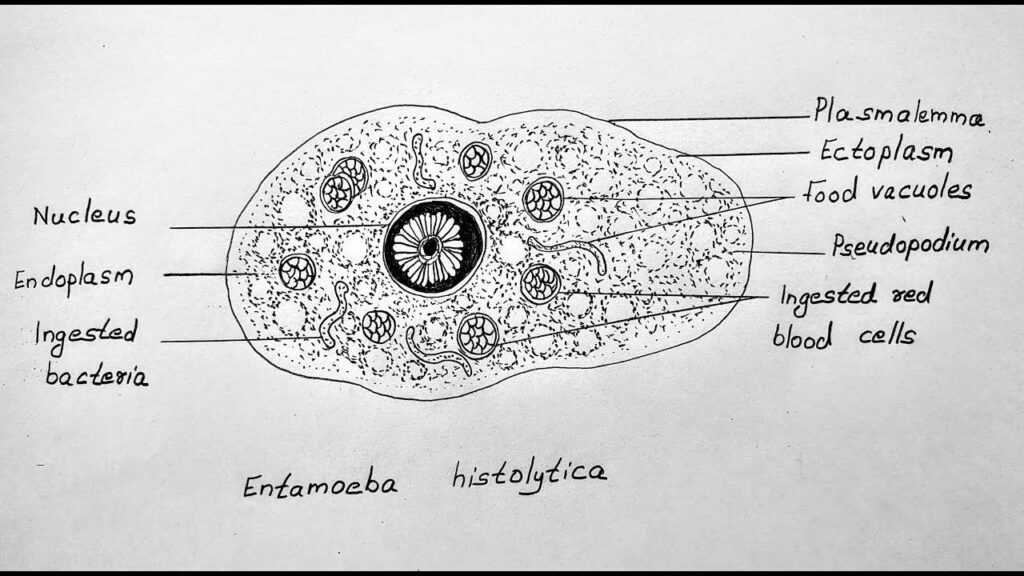
Aim: To study and identify Entamoeba histolytica and comment on the disease caused by it.
Materials required: Permanent slide of Entamoeba histolytica, compound microscope.
Theory: Entamoeba histolytica is a single celled organism. This parasite exists in the form of cyst which are able to survive only for a short period of time outside their normal environment. They particularly thrive in warm or moist conditions, especially in connection with undercooked or improperly stored food.
The Entameoba histolytica is the cause of gastrointestinal illness known as Amoebiasis.
Procedure.
- Clean microscope with the help of cleaning paper.
- Observe the permanent slide of Entamoeba histolytica under microscope under low power followed by high power.
Observation:
Classification.
Phylum: Protizoa
Class: Rhizopoda or Sarcodina
Oderer: Lobosa
Genus: Entamoeba
Species: histolytica
Comments:
- It is monogenetic endoparasite of man found in the upper part of large intestine(colon).
- It occurs in two distinct forms.
- Trophozoite form magna form.
- Precystic form/ minuta form.
- Trophozoite form
- It is active and feeding stage which is pathogenic in nature.
- Contractile vacuole is absent.
- Monopodial conditional is present and pseudopodia.
- Precystic forms
- It is spherical and inactive stage.
- It encysts only in the lumen of intestine and not in tissue.
- It causes amoebiasis (amoebic dysentery)
Mode of infection.
Food and water conatmiated wiyth cyst of Entaenoba. Terataucleated stage is the infective stage.
Symptoms of Amoebic Dysentry.
- Constipation.
- Abdominal pain and cramnps.
- Stoll with excess mucous and blood clots.
Prrecautions:
- Handle the museum Specimen carefully.