
General Instructions:
- Copy the given assignment of practical in fair practical copy of biology.
- Make the use of black pen for heading and sub-headings and blue pen for writing other content.
- Work should be presentable.
- Make well labelled and proper diagram as provided in this assignment.
Spot No.11
Aim: To study prepared pedigree chart of genetic traits such as rolling tongue, blood groups, ear lobes, widow’s peak and colour blindness.
Material Required: Pedigreed chart of these diseases.
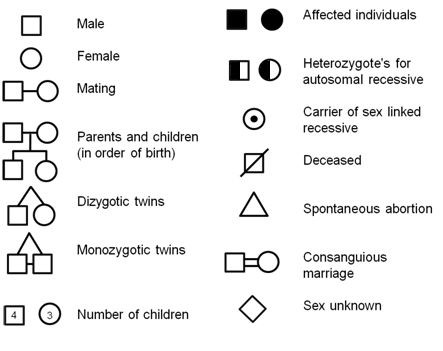
Theory: The Mendelain concept of dominance and segregation can also be studied in humans by preparing and then analysing the pedigree charts. The internationally approved symbols for indication males and females, marriages, various generations etc are given below.
Procedure:
- Selects a family in which any one of the monozygotic trait such as rolling tongue, widow’s peak, blood group, red-green colour blindness etc is found.
- Ask the person exhibiting the traits to tell in which of his/her parents, grandparents (both maternal and paternal) their children and grandchildren the trait in question is present.
- Among surviving individuals the traits may also examined.
- The information made available is the basis for the preparation of pedigree charts using the appropriate symbols.
- A careful examination of the pedigree charts would suggest whether the gene for the character is autosome linked dominant or recessive, X chromosome linked dominant or recessive, Y chromosome linked or not
Explanation:
- Autosome linked dominant trait.
- In this, the encoding gene is present on any one of the autosome.
- The wild type allele is recessive to its mutant allele the mutant allele is dominant.
- Transmission of traits occurs from parent of either sex.
- Males and females are equally affected.
- The pedigree is vertical i.e the trait is marked to be present in each of the generation.
- Multiple generations are characteristically affected.
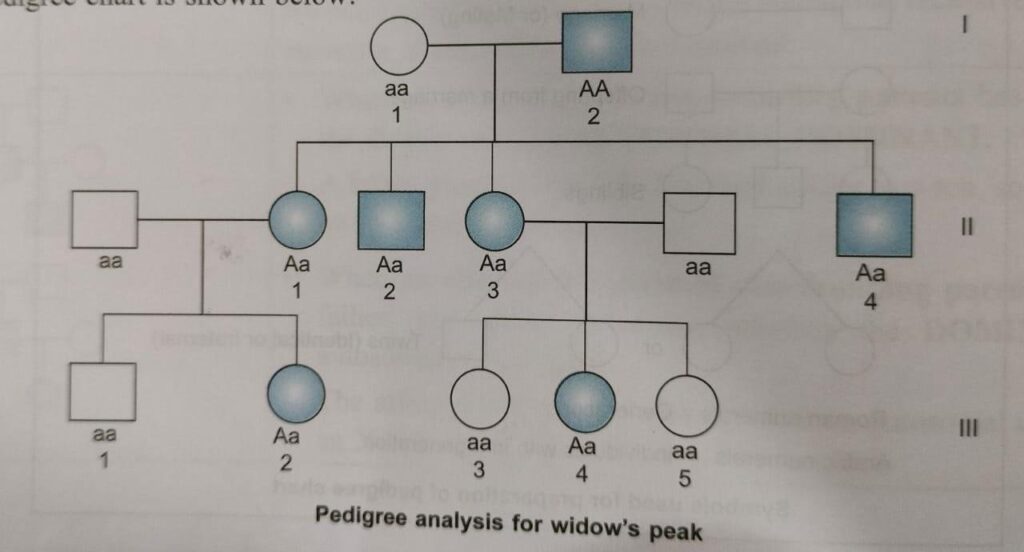
Widow’s Peak
- It is a hair line that forms distinct peak as it crosses the forehead. It is a dominant trait. Thus, homozygous dominant or heterozygous individuals have widow’s peak whereas homozygous recessive individuals have straight hair lines.
- Autosomal Recessive traits
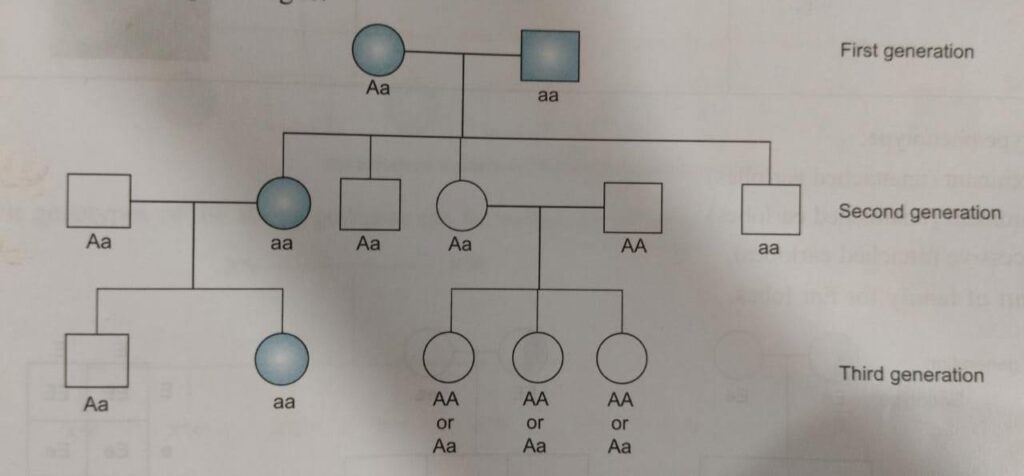
- In this mutant allele is recessive to its wild type allele.
- Occur in equal proportions in multiple male and female siblings whose parent are normal but carriers.
- The siblings are homozygous for the defective allele, but their parents though some may appear normal are obviously heterozygous i.e are merely carriers of the traits.
Tolling of tongue
- It is the ability of a person to roll the tongue in U shape.
- The inability to roll the tongue is caused by an autosomal recessive allele ‘a’. Thus both homozygous dominant AA and heterozygous Aa individual are able to roll the tongue while homozygous recessive aa individual are unable to roll the tongue.
Fused Ear lobes.
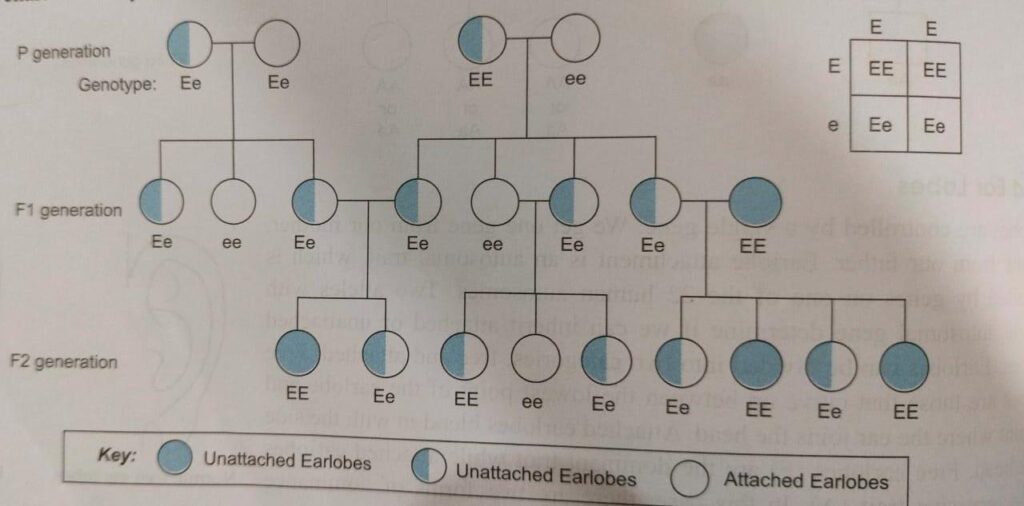
- Ear lobes are controlled by single gene. We got one gene from our mother and one from father. Earlobe attachment is an autosomal trait, which is controlled by gene on one of the 22 human autosomes. Two allele with a single autosomal gene determine if we can inherit attached or unattached earlobes.
- Earlobes can be divided into two categories, free and attached.
- Free earbobs are those that curve up between the lowest point of the earlobe and the point where the ear joins the head. Attached earlobe blend in with the side of head where the ear joins the head. Attached earlobe blend in with side of the head.
- Free earlobes F are the dominant trait while attached earlobes are recessive traits A. In this case, there are two forms of dominance for unattached earlobes, homozygous and heterozygous dominant, attached earlobes are considered homozygous recessives.
- Eralobe nad genotyoe/phenotype.
- EE: Dominant (unattached earlobes)
- Ee: Dominant (unattached earlobes)
- Ee Recessive (attached earlobes)
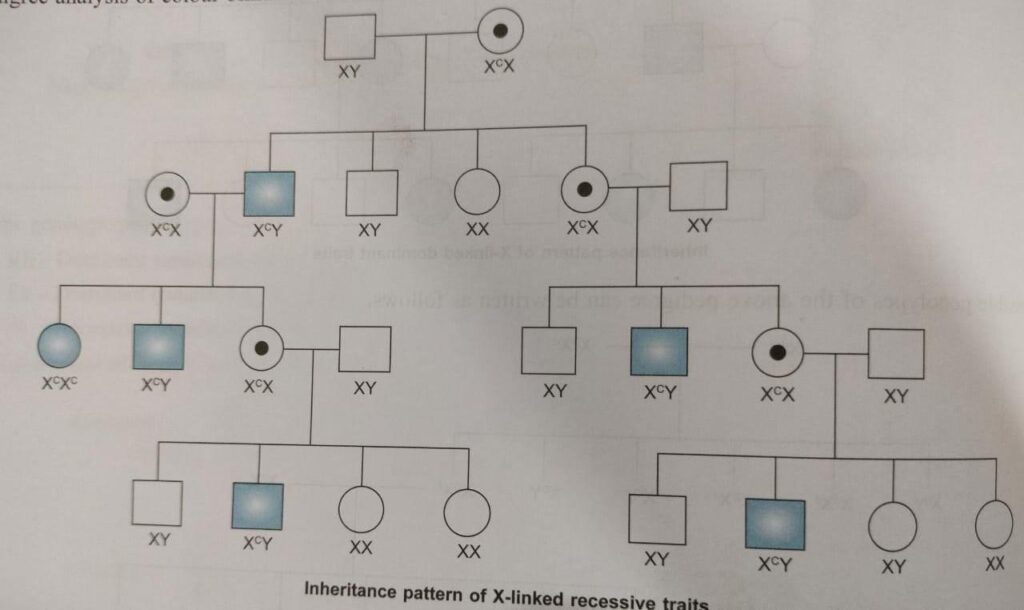
- X linked Recessive traits
- These are the traits whose encoding genes are present on the X chromosome and its mutant allele is recessive to its wild type allele.
- Female express the trait only when they are homozygous for the mutant allele, whereas male do so even when they are homozygous for it.
- About half of the sons of the carrier female are affected. In case of homozygous female showing the trait, fifty percent of her daughter and all other her sons are likely to be affected. Therefore the male are most affected in the population
Colourbindess
- Colour blindness is a sex linked recessive disorder in which the affected individual is not able to differentiate between red and green colours.
- Affected person are one other through the maternal side of their family.
- Any evidence of male to male transmission of the trait riles out the X linked inheritance
Blood Group Inheritance.
- It is independent of sex of the organism
- It is a case of three alleles i.e Ia,Ib.Io
- Ia, Ib are co-dominant while Ia and Ib are completely dominant over Io
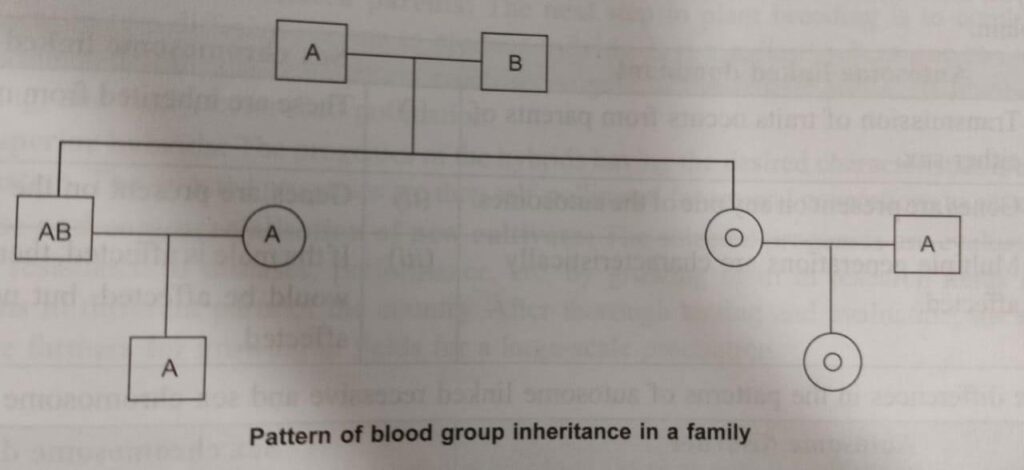
Observations: The investigated families showed the characteristic symptoms of the genetic disorder inferred in the studies undertaken for the pedigree analysis.
Result: The families that we studied showed the transmission of traits responsible for genetic disease in the successive generation in each category.
Precaution:
- To identify the presence of a disorder in pedigree analysis, we must have knowledge of genetic disorders.
- Family history of at least 4-5 generation must be known.